All template scripts can be arbitrarily combined, and can be customized for the special requirements of your game. They are permanently improved and extended. From version A8 on, new scripts will become regularly available in the template section of the user forum, and in the user magazine AUM. Once you know how to program in lite-C, you can create template scripts yourself (see Template Writing Guide).
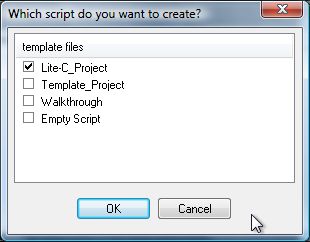
To add a template script to your game, you must first create a game script in WED through File / Map Properties / Script / New. A requester will pop up where you can select the between several script templates. Note that the level must been given a name by File / Save As.. before you can create a script for it.
The available scripts depend on the script templates in the templates folder, so the dialog can look different. By default, the following scripts can be created in A8:
The script gets the same name as the level, but with ".c" extension. Once you've created a template main script, you can add, remove or customize the script templates that you need for your project, using File / Project Manager.
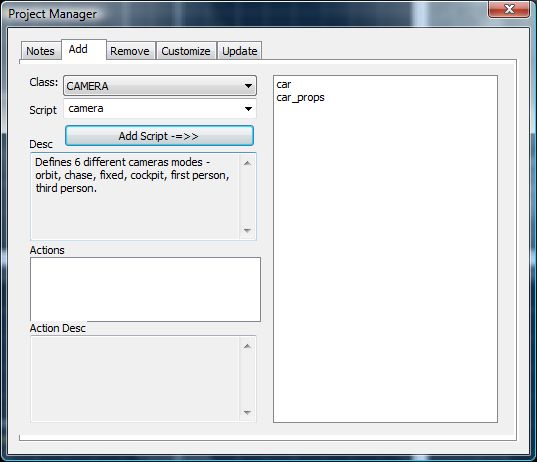
| Notes | Allows to add notes and comments to your game. Use this to keep track of script changes. |
| Add |
Add a template script. On the right side
you'll see the scripts that are already added to your main script.
The templates are divided in several classes - such as car,
camera, and so on. Each class contains several scripts, and
each script can contain one or more actions that are attacheable to
an entity. Select a class and a script, then click the Add
Script button.
Added scripts are automatically copied from the templates/code folder
into the work folder, and are included into
the main game script. |
| Remove |
Remove a template script if it's functions are no longer needed. In the Needed By field you'll see which scripts are dependent on the selected script. Don't remove a script that is needed by other scripts. |
| Customize | Select a script, then click Customize to adapt its parameters to your game. A Customize panel (see below) will pop up and allow to edit script parameters. Most template scripts contain customizable fields. If you want to create your own Customize panels for your own scripts, use Comment Tags. |
| Update | Update a script from a newer set of templates, without losing the customized parameters. Use this after having downloaded an update from the Gamestudio website or forum. |
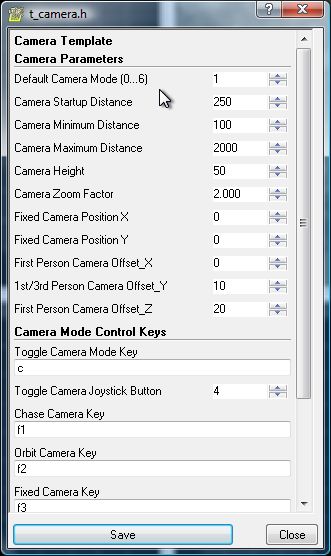
The Customize dialog modifies the local template script copy that the Project Manager has created in your work folder. Click on the [?] icon in the upper right corner of the dialog. Then click on the text of one of the 'tags' in the dialog. If that tag has a "help" text, it will be displayed in a pop-up window. Click on [Save] to save the modifed values to the local script copy. The above image shows the template for the camera library.
► latest version online